













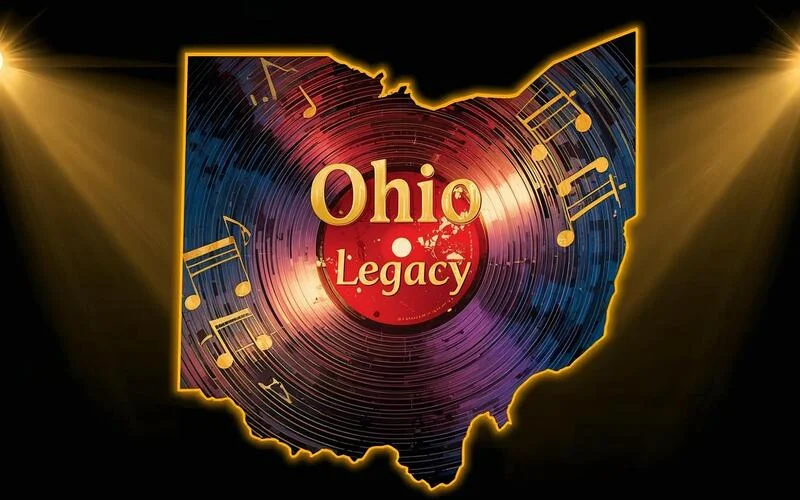
Long before charts and recordings, music in Ohio existed as a shared language. Drums, fiddles, and voices carried through settlements and river towns, shaped by migration and memory. The sounds blended traditions—Appalachian folk, African rhythms, church hymns—forming something distinct but not yet named.
By the early 20th century, cities began to define that sound.
In Cleveland, industry roared, and so did the music. Jazz ensembles filled clubs, and radio stations became powerful cultural engines. In the 1950s, a radio disc jockey—Alan Freed—broadcast a new, electrified style to a growing audience. He called it “rock and roll,” giving identity to a sound already taking shape. The city soon became synonymous with the genre’s rise, eventually housing the Rock and Roll Hall of Fame.
Elsewhere, Ohio’s musical branches spread in different directions.
In Dayton during the 1970s, funk took hold with explosive creativity. Bands layered heavy bass, sharp guitar riffs, and brass into a groove that was both danceable and defiant. The “Dayton sound” influenced artists far beyond the Midwest, embedding itself into the DNA of modern R&B and hip-hop.
Meanwhile, Cincinnati cultivated soul. Recording studios and local labels supported artists whose music carried emotional depth and technical precision. Gospel roots remained strong, shaping vocal styles that resonated across generations.
As decades passed, Ohio adapted.
The late 20th century saw darker, more experimental tones emerge. From Cleveland came industrial rock that fused aggression with electronic textures, while alternative and indie scenes grew in Columbus. Basement shows, college radio, and independent labels pushed boundaries, allowing artists to explore identity and sound without constraint.
Hip-hop also found a strong foothold. Fast-paced lyrical styles and melodic flows emerged from Ohio cities, contributing to the genre’s evolution in unexpected ways.
Through each era, a pattern remained consistent: Ohio did not follow trends—it absorbed and reshaped them. Its geographic position, cultural diversity, and industrial history created a meeting point where musical traditions collided.
The history of Ohio music is not linear. It moves like a loop—borrowing from the past, transforming in the present, and echoing forward. From unrecorded folk melodies to globally influential genres, the state’s contribution lies not in a single innovation, but in its continuous reinvention of sound.